The Case for Line
Opening markets through structured supply infrastructure
Line in a Paragraph
Group business in hospitality is a trillion dollar category1 that still runs on manual workflows inside a closed and opaque marketplace. This market could not behave like an efficient market before because the core supply inputs, availability, pricing logic, constraints, and contracts lived in human judgment and documents rather than machine readable systems, making real time matching, execution, and transactions impossible. When supply becomes structured, executable, and programmable, the market can finally allocate supply and demand efficiently. Transparency, real price discovery, and healthier conditions for guests and properties emerge as a result. These outcomes require an infrastructure layer that structures supply and enables executable workflows between supply and demand, which is the role Line is designed to play.
Line in a Page
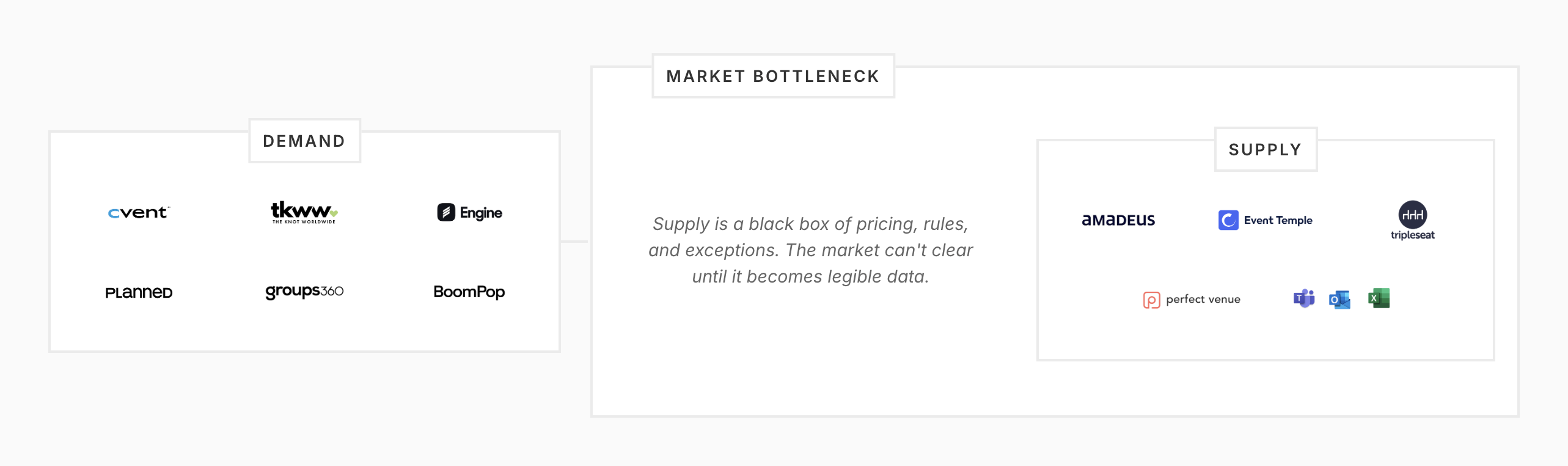
The core wedge in group hospitality is the broken space between demand and supply. Both sides have evolved, but the handoff between them has not. This is where the system collapses.
Demand is getting better at generating and aggregating interest
- Direct inquiry forms
- Cvent
- BoomPop
- PartySlate, Engine, and other modern facilitators
These tools improve discovery and planning, but once structured demand reaches supply, it enters an opaque, operator focused workflow environment that cannot accept structured inputs.
The missing middle layer is the real bottleneck
This is where demand meets supply and where the category repeatedly fails. Line focuses on the foundational components required to fix it:
- Structured knowledge
- Inventory and constraints
- Collaborative workflows
Together, these form the matchmaking wedge the category has never had.
Supply systems were never designed for interoperability
- Tripleseat
- Perfect Venue
- Delphi
These systems do not expose availability, constraints, pricing logic, or business rules in a machine readable way. They were built for operators, not for a two sided market.
Why this wedge matters
- Real time qualification and execution
- Transparent fit, pricing, and constraints
- Open market behavior
- Who reshapes the category
The platform that solves this wedge, likely originating on the supply side and then connecting deeply into demand, gains the leverage to transform the category.
What happens next
Demand platforms can integrate with a supply layer or extend downward into inquiry-to-invoice workflows, charging only on bookings. Properties adopt unified rails instead of fragmented software. This creates a true two sided marketplace built on:
- Sales workflows
- Collaborative tooling
- A standardized transaction layer
A familiar pattern from other markets
- Stripe (devs and banks)
- Airbnb (guests and hosts)
- Uber (riders and drivers)
- Shopify (stores and fulfillment)
Supply usually bends to demand, which pushes markets toward transparency, speed, and real time flows. Structuring supply is the unlock that lets demand side innovation finally create a functioning market in group hospitality.
For a ground level look at the guest and property experiences behind this market and the deeper problem that creates the hidden, convention driven system described in this paper, see Part I: A Problem Worth Solving.
Table of Contents
- I. Introduction
- II. Demand Landscape
- III. Supply Landscape
- IV. Why Now
- V. Introducing the System of Work
- VI. Elements of the Supply Orchestration Layer
- VII. Why Demand Platforms Struggle Solving Supply
- VIII. Market Implications When Supply Becomes Legible to Demand
- IX. Conclusion
I. Introduction
Group business in hospitality is a one trillion dollar market1 spanning conventions, corporate events, weddings, retreats, meetups, amusement park groups, and any booking that requires private group space or nine or more rooms. The category still operates through RFP driven, manual workflows that keep both demand and supply inside an opaque and closed marketplace. Friction is high, information is fragmented, and price discovery becomes guesswork.
The core constraint is supply in group hospitality was never represented as data. Availability, pricing logic, constraints, and contracts lived in human judgment and documents, which made real time matching and transactions impossible. Without a machine readable supply layer, the category could not behave like a programmable market. This paper explores the implications of structured supply and the emergence of an infrastructure layer capable of opening a historically closed market.
II. Demand Landscape
Group bookings come through a mix of traditional and modern demand channels.
Traditional demand channels
- Inquiry forms on venue websites
- Meeting planner networks such as HelmsBriscoe
- RFP platforms such as CVENT2
Traditional channels rely on the RFP convention. Planners identify properties, submit requests for pricing and availability, and properties process large volumes of misaligned inquiries. Even major platforms focus on distributing RFPs rather than matching demand to actual supply.
Modern demand side facilitators
- BoomPop raised 41M dollars3
- Planned raised between 55M and 65M dollars4
- Engine raised more than 200M dollars5
- PartySlate raised 14M dollars6
Modern tools improve user experience and help organizers articulate objectives and requirements. They reduce friction but rely heavily on internal planning teams who manually gather supply information. Because availability, constraints, business rules, and pricing are not structured, demand side innovation cannot enable real time matching or market dynamics.
III. Supply Landscape
On the supply side, group hospitality relies on legacy, operator focused systems that were not designed for interoperability or any form of two sided workflow. These platforms function primarily as internal systems of record. They require human input at every step and keep availability, pricing logic, constraints, and inventory locked inside tribal knowledge rather than exposing them as structured, programmable data that external demand channels can use.
Representative systems include:
- Email, shared spreadsheets, and productivity tools such as Google Workspace and Microsoft 365
- Tripleseat, which raised growth capital and was acquired
- Perfect Venue, which raised $3.6M in seed funding
- Delphi, part of Amadeus Hospitality, which generates approximately $1B in annual revenue
These systems support sales teams, catering departments, and event managers with lead intake, proposals, BEOs (banquet event orders), contract generation, and function space scheduling. All changes to availability, pricing, and constraints are manually entered by staff, and all workflows depend on human coordination. The systems reinforce existing internal processes rather than enabling real time communication between supply and demand.
As a result, supply systems function effectively as internal databases, but they are not programmable and do not automate work. Without a structured and programmable supply layer, on demand matching and transparent market behavior are not possible.
IV. Why Now
Group hospitality is hitting a breaking point. Staffing is compressed, inquiry volume is rising, and guests increasingly expect instant answers. At the same time, search and discovery are shifting toward more distribution channels, social platforms, and AI driven interfaces that expect structured, machine-readable supply.
The reason this has not been solved historically is structural. Group business requires coordination across availability, pricing logic, inventory constraints, and contracting, often involving multiple stakeholders on both sides. Legacy systems forced teams to manage this complexity manually, playing a kind of workflow “Tetris” dependent on human judgment and internal coordination. These systems were built as systems of record, not systems of execution.
The problem persisted for three additional reasons.
- Legacy platforms functioned as systems of record rather than systems of execution. They stored leads, generated proposals, and tracked contracts, but they did not model supply as programmable logic capable of coordinating availability, pricing rules, and constraints in real time.
- Demand platforms could not solve this from the outside. They do not sit inside authoritative property workflows and cannot control availability, pricing logic, or contracting terms. Without neutrality and direct integration into supply systems, they were limited to distributing RFPs rather than enabling real-time matching.
- The inefficiency was economically tolerated. Properties still closed business, sales teams absorbed coordination work, and revenue continued to flow through manual processes. The friction was normalized as convention rather than recognized as infrastructure failure.
What changes now is the convergence of feasibility and pressure. AI systems can now operationalize exception-heavy workflows that historically required human coordination and judgment, making judgment-based workflows programmable for the first time. At the same time, staffing constraints, rising inquiry volume, and distribution shifting toward AI driven interfaces make manual coordination increasingly unsustainable. The structural barriers that prevented programmable supply are collapsing simultaneously.
V. Introducing the System of Work
Once supply is structured, it becomes machine-readable infrastructure for availability, pricing logic, constraints, and contracts. When that system of record is paired with an executable workflow from inquiry to invoice, these supply primitives evolve into an executable coordination layer. The system absorbs the most repetitive, time consuming, and failure prone parts of group sales and coordination, allowing staff to focus on higher judgment work and onsite human engagement.
Data Compounding
As supply becomes structured and workflows are orchestrated, each inquiry, decision, exception, and outcome feeds back into a growing data model that continuously improves how availability is qualified, pricing rules are applied, and constraints are enforced. Over time, this intelligence can be shared with property teams and ownership groups, creating visibility into demand patterns, utilization, and missed opportunities that were previously invisible or anecdotal.
We Have Seen This Pattern Before
Markets become infrastructure when fragmented workflows become structured, executable, and programmable.
| Market | Before | Infrastructure Layer |
|---|---|---|
| Air & hotel travel | Phone calls, travel agents, fragmented inventory | GDS |
| Real estate | Fragmented broker listings | MLS |
| Payments | Bank-by-bank integrations | Stripe |
| Commerce | Independent storefront chaos | Shopify |
| Computing infrastructure | Physical servers, manual provisioning | AWS |
| Software delivery | Manual deployment workflows | GitHub + DevOps |
| Group hospitality | Emails, RFPs, fragmented supply | Line |
Group hospitality remains in a pre-infrastructure stage today, where workflows are fragmented, exception-heavy, and coordinated manually. AI changes this dynamic by making previously unstructured operational workflows executable for the first time.
Opening matchmaking
With a system of work in place, supply can now be qualified, compared, and matched programmatically rather than negotiated manually. Demand tools, however, still generate inquiries without access to availability, constraints, inventory, or pricing logic held inside unstructured supply systems.
Many things will change over time, but a few fundamentals will not. At the center of group hospitality is a trifecta of universal incentives:
- Customers want on demand pricing, availability, and fit.
- Properties want on demand matchmaking to qualify inquiries quickly.
- The market is always seeking on demand matchmaking because it enables liquidity and market clearing.
To align these incentives, matchmaking must provide three missing functions.
- Knowledgeable sales matchmaking is the foundation of modern two sided ecosystems. In ridesharing, the breakthrough was instant matching on structured inputs. Group hospitality has no equivalent. Supply inputs are not structured or exposed, so even strong inquiries collapse into RFP workflows, and matchmaking converts demand into structured, match-ready opportunities.
- Collaborative tooling in other verticals relies on shared workspaces such as Git, GitHub, Basecamp, and Linear that allow multiple parties to collaborate with clarity. Group business has no equivalent, and guests and properties rely on email threads, PDFs, and attachments, creating slow and fragmented workflows.
- A transaction layer underpins marketplaces with standardized pricing, terms, agreements, and payments. Group hospitality lacks a shared transaction layer connected to contracting logic, so proposals and contracts live inside property systems and cannot be executed externally. Without a transaction layer originating from supply, demand platforms cannot complete workflows or create liquidity.
Markets become programmable when supply can be represented, matched, coordinated, and transacted programmatically rather than negotiated manually.
VI. Elements of the Supply Orchestration Layer
For group hospitality to operate with transparency, liquidity, and real marketplace dynamics, the supply orchestration layer assembles the following elements into an executable system of work that spans the full inquiry-to-invoice lifecycle.
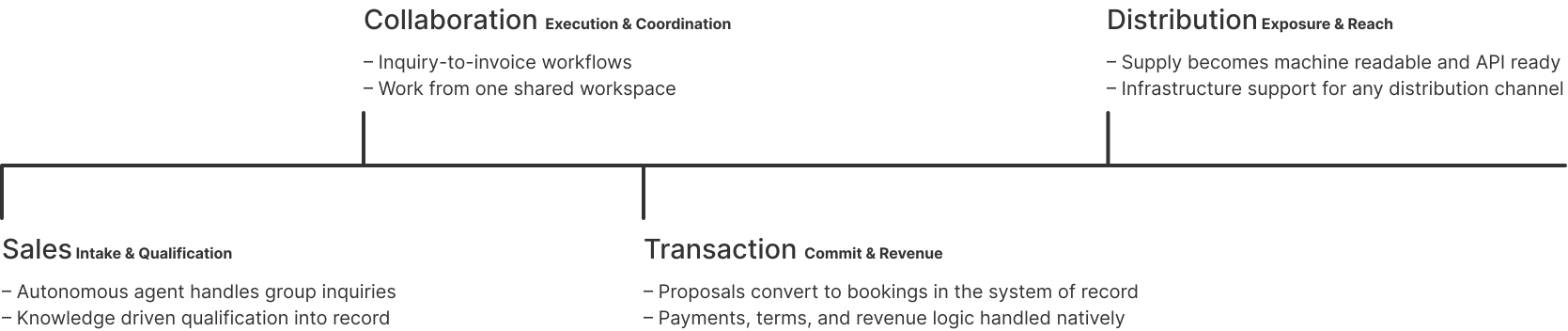
- Sales and Intake (System of Record)
Direct integration with property workflows so authoritative supply data lives inside the property and availability, inventory, constraints, pricing logic, business rules, and contracting are captured at the source, allowing inquiries to be qualified against real constraints in real time. - Supply Modeling (Machine Readable Infrastructure)
A structured, machine readable supply model where availability, inventory, and business rules are represented as data that external systems can query. Documents and PDFs cannot support programmatic matching, execution, or market behavior. - Collaboration (Execution and Coordination)
A unified, two sided collaboration workspace so group bookings involving multiple stakeholders do not fragment across email threads and attachments. Guests and properties coordinate requirements, changes, and decisions within a single shared workflow. - Transactions (Commit and Revenue)
A standardized transaction layer where pricing, terms, contracts, and payments flow through consistent rails that can be executed programmatically. The binding agreement between guest and property connects directly to contracting so commitments can be made without reverting to manual procurement workflows. - Distribution (Exposure and Reach)
Neutrality across demand sources so the supply orchestration layer behaves like infrastructure any channel can call equally. As supply becomes machine readable and API-ready, it can support new distribution interfaces over time without recreating bespoke integrations.
VII. Why Demand Platforms Struggle Solving Supply
Demand platforms do not sit inside the property and do not act as systems of record. They lack access to core inputs such as availability, inventory, constraints, business rules, and contract terms. As a result, they cannot reliably qualify, price, or execute against real supply conditions.
There is also a structural conflict of interest. Demand platforms position themselves as buyer advocates, which prevents them from acting as neutral infrastructure or being trusted with authoritative pricing logic and constraints. Without neutrality and accurate supply modeling, no true market can form.
Because of this, the infrastructure layer must originate from the supply side or from a neutral coordination layer embedded directly inside property workflows. Once such a layer exists, demand platforms can integrate with it or partner with it without needing to own supply modeling or execution themselves.
How incentives change once supply is structured
Once the supply side is structured within a neutral supply orchestration layer, the incentive landscape shifts. Availability, constraints, pricing logic, and contract terms become standardized, executable inputs that all channels can access programmatically. Demand platforms no longer need negotiation or buyer advocacy to differentiate. Their advantage becomes distribution, routing, and experience.
At this point, both the demand and supply layers can begin to function like a healthy market, with supply orchestration providing the shared infrastructure between them. The authoritative supply model connects to demand in a neutral, programmatic way. Matching becomes algorithmic, pricing becomes rule based, and transparency replaces the asymmetry that previously required manual workflows.
VIII. Market Implications When Supply Becomes Legible to Demand
As structured supply reaches critical mass and becomes legible to demand, the market begins to behave like a market.
- Transparent market behavior emerges as availability, constraints, and pricing signals become visible and executable, allowing decisions to be made faster.
- Liquidity increases as real-time matching shortens sales cycles, improves conversion, and reduces RFP churn.
- Distribution evolves as programmatic access to supply enables two natural distribution paths:
- Path A: vertically integrated distribution experiences, including group marketplaces or OTAs (online travel agency), built on structured supply.
- Path B: a neutral supply infrastructure that multiple demand interfaces can route qualified opportunities against simultaneously.
- In both cases, the defining shift is that distribution is no longer constrained by manual supply workflows.
- The economics shift once workflow software becomes market infrastructure. Instead of seat-based SaaS subscriptions, pricing moves toward outcome based models, such as a percentage of bookings executed or revenue cleared, directly tying cost to value creation.
- Competitive pressure builds as properties with structured supply gain speed and clarity advantages, forcing regional adoption as others follow.
- Foundations of an efficient market form as structured supply and shared transaction rails create the prerequisites for liquidity, consistent allocation, and price formation.
IX. Conclusion
Until availability, constraints, pricing logic, and contracting live in a standardized, machine readable layer, the category cannot behave like a market. Once supply is orchestrated, matching becomes instant, transactions become consistent, and discovery can operate across many interfaces. The path to a programmable group hospitality market begins with structured supply. Marketplaces, distribution models, and new interfaces emerge downstream once the infrastructure layer exists.
Author’s Note
Line is developing the infrastructure layer described throughout this paper, modeling availability, inventory, constraints, pricing logic, and contracting directly inside property workflows. As this infrastructure scales, demand side innovation can finally connect to structured supply, enabling the transparency and real time matching that the category has never had.
Today, Line begins narrowly by structuring property supply and automating qualification and coordination for inbound group inquiries. The goal is to first absorb coordination work directly inside property workflows. As supply becomes structured across properties, the infrastructure layer described above emerges incrementally.
1 The broader group hospitality ecosystem, including meetings, events, group travel, and weddings, clearly exceeds a trillion dollars annually. Oxford Economics and the Events Industry Council estimate the global business events economy at $1.6 trillion per year, and Grand View Research places the global wedding services market at $899.6 billion in 2024, projected to exceed $1.8 trillion by 2030. Additional analyses from the U.S. Travel Association, the World Travel and Tourism Council, Meeting Professionals International, and Zion Market Research support the scale and growth of this category. See the Events Industry Council, Grand View Research, the U.S. Travel Association, the World Travel and Tourism Council, Meeting Professionals International, and Zion Market Research.
2 CVENT was acquired by Blackstone in 2023 for approximately 4.6 billion dollars. Prior to the acquisition, CVENT reported more than 630 million dollars in annual revenue for fiscal year 2022, and public filings and company statements noted that the CVENT Supplier Network included more than 300,000 hotels and venues globally. These figures reflect CVENT’s position as a dominant traditional demand side platform focused on RFP distribution rather than real time supply matching. See CVENT’s acquisition announcement, its 2022 financial results, and related company filings.
3 BoomPop announced a 41 million dollar funding package in 2025 that included 25 million dollars in equity and 16 million dollars in credit. See BusinessWire, PhocusWire, and the BoomPop Blog.
4 Planned raised approximately 55 to 65 million dollars across Series A and B rounds, including a 35 million dollar Series B and an 18 million dollar Series A. See Planned’s Series B announcement, Forbes, and Tracxn.
5 Engine raised more than 200 million dollars, including a 140 million dollar Series C in 2024 at a 2.1 billion dollar valuation and a 65 million dollar Series B at a 1.3 billion dollar valuation. See the Engine Newsroom, Reuters, and SiliconANGLE.
6 PartySlate raised approximately 14 million dollars across seed and Series A rounds. See Tracxn, PartySlate’s Series A announcement, and CB Insights.
7 Tripleseat has raised approximately 9 million dollars in growth funding and was later acquired by Vista Equity Partners, with a subsequent recapitalization by General Atlantic. Industry reporting has estimated around 60 million dollars in annual recurring revenue. See Level Equity’s 7M investment, Level Equity’s 2M follow-on, Vista’s acquisition announcement, and Reuters ARR estimate.
8 Perfect Venue raised 3.6 million dollars in seed funding in 2022 to expand its event management platform. See VCJ’s report on the 3.6M seed round.
9 Amadeus reported €991.3 million in 2024 revenue for its Hospitality & Other Solutions segment, which includes Delphi and MeetingBroker. See the Amadeus 2024 financial results.