Distribution Follows Structured Supply
How Line Opens the Market Through Ground Game and Network Expansion
Line Distribution in a Paragraph
Line spreads by structuring supply inside property workflows and expanding outward from those deployments. The first stage is founder led sales inside initial properties, where the system becomes embedded in real group sales operations. Once supply becomes structured, distribution expands through the natural structure of the industry. Successful deployments spread across property portfolios operated by management companies and ownership groups. Demand platforms and discovery interfaces increasingly route inquiries to properties that can respond instantly, increasing visibility for participating venues. Independent venues adopt the system through lightweight deployments, while discovery surfaces expose structured supply to the broader market.
Markets naturally gravitate toward systems that provide instant pricing, availability, and fit. As supply becomes structured, group hospitality shifts away from slow RFP workflows toward real time coordination between supply and demand. Distribution compounds as structured supply accumulates. Each new property increases the value of the network, attracting additional demand channels and accelerating adoption across the industry.
Line Distribution Ladder
Distribution Ladder: From Structured Supply to Market Infrastructure
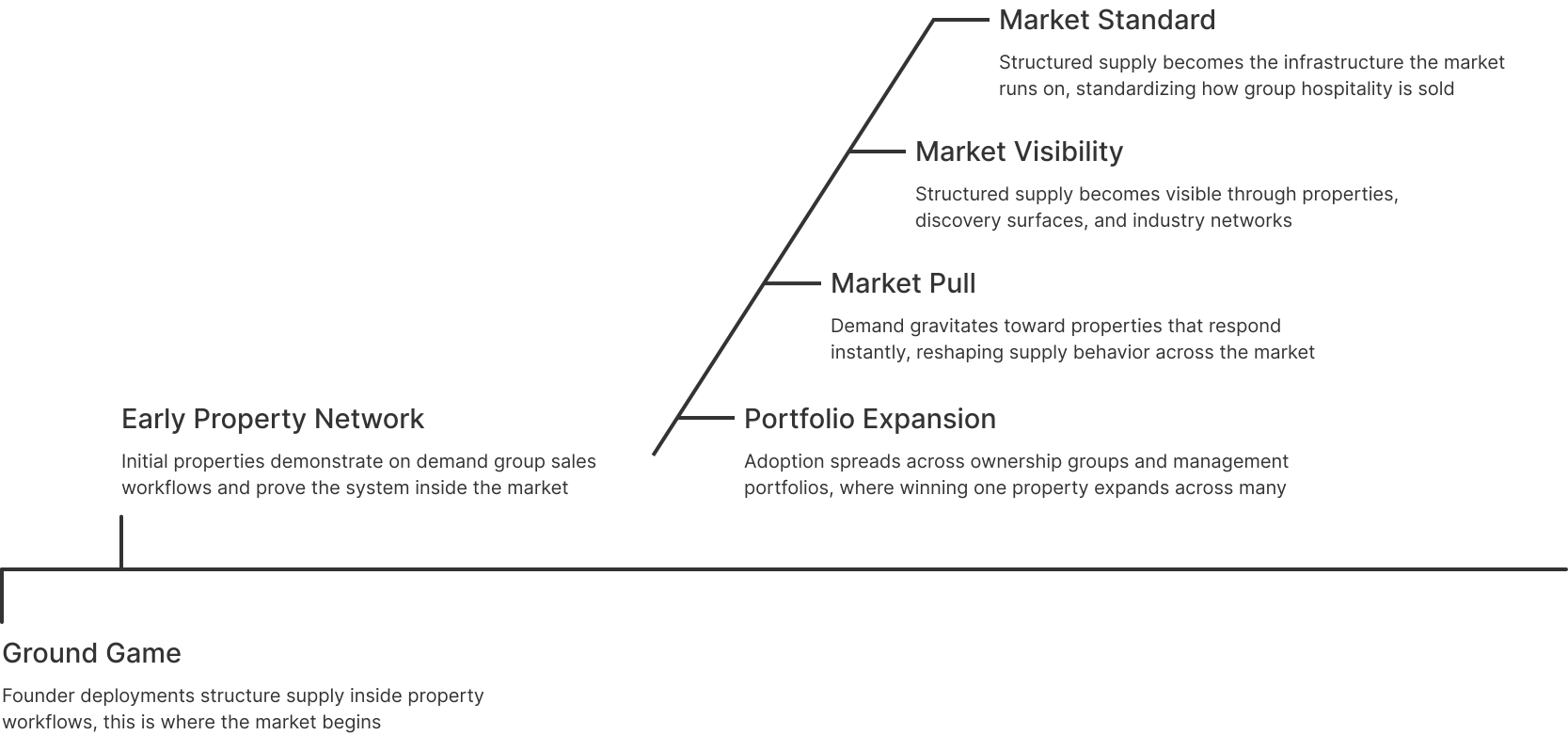
Line distribution in a visual follows structured supply. As supply becomes structured inside property workflows, distribution expands from founder led deployments to portfolio expansion and eventually market infrastructure.
Line Distribution in a Page
The Governing Principle
Distribution follows structured supply.
When supply becomes structured inside property workflows several dynamics emerge simultaneously. Properties gain the ability to respond instantly to inquiries. Demand channels gain reliable inventory they can route opportunities against. Distribution channels gain machine readable supply they can integrate. Competitors adopt similar systems to remain competitive.
Marketing introduces operators to the system, but adoption accelerates because structured supply becomes the most valuable node in the ecosystem.
The Ground Game
Every new market begins somewhere. In group hospitality it begins inside properties.
The first hundred deployments must be founder led. Hospitality is an operational industry where credibility and trust matter. Operators want partners who understand how group business actually works inside a property.
Early deployments structure the first supply layer and reveal how group hospitality actually operates. This phase requires time inside properties, but it creates the foundation the rest of the distribution system builds upon.
Portfolio Expansion
Hospitality technology rarely spreads property by property. It spreads portfolio by portfolio.
Properties sit inside ownership groups, management companies, and brand networks. Because of this structure, a successful deployment rarely remains isolated.
Winning the right property often unlocks distribution across an entire portfolio.
Product Led Expansion
As structured supply becomes visible across the market, adoption expands.
Independent venues adopt lightweight deployments with minimal integrations. Larger properties increasingly adopt through agent assisted onboarding that translates operational knowledge into structured supply.
Over time, improvements in the system make adoption progressively easier and distribution expands across the market.
Demand Pull
Demand for group hospitality originates from planners, RFP platforms, search, social media, and emerging AI driven assistants.
These interfaces do not control supply. Availability, pricing logic, and constraints remain trapped inside property workflows.
When supply becomes structured, properties respond instantly to inquiries and demand channels route opportunities against real inventory. Markets reorganize around systems that enable these conditions.
Market Infrastructure
As structured supply accumulates, distribution compounds.
- Founder deployments structure the first supply layer.
- Portfolio expansion spreads adoption across property networks.
- Demand channels route opportunities to structured supply.
Structured supply becomes the coordination layer the market organizes around.
Supply creates the market.
Pricing follows workflow ownership.
Distribution follows structured supply.
Table of Contents
- Line Distribution in a Paragraph
- Line Distribution in a Page
- The Governing Principle
- I. The Ground Game
- II. Distribution Through Portfolios
- III. Industry Networks
- IV. Product led Growth
- V. Demand and Markets Gravitate Toward Structured Supply
- VI. Visibility and Learning Surfaces
- VII. Open Standards and Ecosystem Contributions
- VIII. Distribution Loops
- IX. Competitive Pressure
- Conclusion
The Governing Principle
Distribution follows structured supply.
When supply becomes structured inside property workflows, several dynamics emerge simultaneously.
- Properties gain the ability to respond instantly to inquiries.
- Demand channels gain reliable inventory they can route opportunities against.
- Distribution channels gain machine readable supply they can integrate.
- Competitors adopt similar systems to remain competitive.
Marketing and awareness introduce operators to the system, but adoption accelerates because structured supply becomes the most valuable node in the ecosystem.
I. The Ground Game
Every new market begins somewhere. In group hospitality it begins inside properties.
The first hundred deployments must be founder led. Hospitality is an operational industry where credibility and trust matter. Operators want partners who understand how group business actually works inside a property.
Early deployments accomplish several critical things simultaneously.
- They reveal the real workflow behind group business. Sales teams coordinate inquiries through inboxes, spreadsheets, legacy systems, and human judgment. Observing these workflows allows the system to be built around reality rather than assumptions.
- They establish trust with operators. Technology decisions in hospitality are rarely made in isolation. Sales teams, catering managers, and general managers all participate in operational decisions.
- They reveal the network behind each property. Hospitality properties rarely operate alone. Each property connects to a larger organizational structure that shapes how technology spreads.
The ground game therefore serves two purposes: structuring supply and mapping the network through which distribution later expands.
Early deployments require significant time inside properties and direct collaboration with operators. This makes the initial phase of the flywheel slower than traditional SaaS distribution.
However, the structure of the hospitality industry makes this investment unusually powerful. Properties sit inside ownership groups, management companies, and brand networks. Winning the right property often exposes an entire portfolio of related properties.
In this sense, the ground game is not simply customer acquisition. It is the process of planting the first nodes of structured supply that the rest of the distribution system builds upon.
II. Distribution Through Portfolios
Hospitality technology rarely spreads property by property. It spreads portfolio by portfolio.
Most properties sit inside three overlapping structures.
- Ownership groups that own the asset
- Management companies that operate the property
- Brands that provide standards and distribution
Because of this structure, a successful deployment rarely remains isolated. When a system proves valuable to an on site team, it quickly becomes visible across the broader network surrounding that property.
- Management companies often operate dozens of hotels.
- Ownership groups frequently control regional portfolios.
- Brand commercial teams coordinate sales activity across multiple properties.
This creates a natural expansion path. One property becomes several. Several become regional rollout. Regional rollout becomes enterprise adoption.
Portfolio expansion bridges early founder led deployments and industry scale distribution.
Because technology decisions frequently propagate through these networks, winning a single strategically positioned property can unlock distribution across an entire portfolio. In practice, winning fifty properties may only require winning the right one.
III. Industry Networks
The hospitality industry contains centralized professional networks where commercial leaders gather. Industry organizations such as HSMAI (Hospitality Sales and Marketing Association International) connect sales leaders, commercial directors, brand executives, and portfolio operators who influence how operational practices spread across the market.
Because these communities are tightly connected, a successful deployment at one property often becomes visible to peers across a region, brand group, or ownership network. Participation in these ecosystems exposes decision makers responsible for large property portfolios.
Bottom up property relationships and top down industry networks reinforce one another, accelerating how new operational systems spread across the industry.
IV. Product led Growth
Product led growth in hospitality requires a foundation of trust and market visibility. Operators in this segment are accustomed to relationship driven sales cycles and established vendors. As a result, early distribution relies on direct deployments that establish credibility within the industry.
Once structured supply becomes visible across properties and portfolios, product led adoption becomes more viable. At that point operators can observe the system working inside the market and are more willing to adopt it directly.
Product led growth in hospitality has historically been difficult because structuring supply requires capturing operational knowledge such as availability rules, pricing logic, constraints, and event logistics. This information typically lives inside documents, spreadsheets, and human judgment rather than systems that can be configured quickly.
Line introduces structured supply models that allow properties to manage this knowledge as durable, versioned data. As this foundation improves, product led adoption becomes possible across multiple segments of the market.
Independent venues
Many venues operate independently and require minimal integrations.
Examples include:
- Wedding venues
- Restaurants with event space
- Boutique hotels
- Independent event venues
For these venues a lightweight standalone deployment is sufficient. They do not require complex integrations or enterprise implementation.
Product led adoption allows these properties to structure supply and begin responding instantly to inquiries without requiring founder led onboarding.
Agent assisted adoption
More complex properties historically required hands on onboarding because structuring supply meant translating operational knowledge into systems.
Line is building an internal agent that guides operators through this structuring process. The agent asks questions, captures operational details, and translates property knowledge into structured supply.
As the system learns from more deployments, onboarding becomes progressively easier. Over time the system's ability to guide operators through supply structuring can scale beyond founder led implementation.
Product led growth therefore expands distribution in two ways: lightweight adoption for simpler venues and progressively automated onboarding for more complex properties.
V. Demand and Markets Gravitate Toward Structured Supply
Demand for group hospitality originates from many places.
Traditional platforms such as Cvent distribute requests for proposals across venue networks. Newer platforms such as BoomPop, Engine, Planned, and PartySlate aggregate inquiries from corporate planners, wedding planners, and event organizers. Discovery increasingly occurs across social media, search, and emerging AI driven assistants that help guests identify venues and plan events.
Despite their differences, these interfaces share the same constraint. They do not control supply.
Availability, pricing logic, constraints, and contract terms remain trapped inside property workflows. Because these inputs live in documents, spreadsheets, and human judgment, external systems cannot match demand to real inventory in real time.
Without structured supply, every demand interface eventually falls back to the same mechanism: sending an inquiry and waiting for a response.
Across industries, markets naturally move toward systems that reduce friction between supply and demand.
Ridesharing replaced dispatch systems with instant matching between riders and drivers. Online travel replaced phone reservations with real time booking across airline and hotel inventory. E commerce replaced catalog orders with live inventory and checkout.
Group hospitality remains one of the few large commercial categories still operating through a request for proposal convention. The process resembles a procurement workflow more than a functioning market.
This is not because regulations require it. There are no rules forcing the industry to operate this way. What is missing is a standard representation of supply.
Once supply becomes structured, the dynamics change immediately.
- Guests receive instant pricing, availability, and fit.
- Properties qualify inquiries faster and reduce coordination work.
- Demand channels route opportunities against real inventory.
Markets reorganize around the systems that enable these conditions. Distribution therefore emerges not only from sales effort but from the underlying economics of the market itself.
VI. Visibility and Learning Surfaces
Not every distribution channel is a direct sales motion. Some surfaces exist to expose the system, share learning from the field, and make the emerging market visible.
As supply becomes structured, operational knowledge that once lived inside documents and inboxes becomes observable data. This creates opportunities to showcase how group hospitality operates when supply is structured.
One conceptual example is a discovery environment where agents representing participating properties can surface their knowledge and interact with inquiries directly. Because these agents are trained on structured property data, they operate as knowledgeable sales interfaces capable of responding instantly to group inquiries.
In such environments agents representing different properties could demonstrate how deals are qualified and expose the operational dynamics behind hospitality sales.
The purpose of these surfaces is not primarily to sell the software itself. Instead they make the system observable.
- They show how properties respond instantly to inquiries.
- They surface operational insights emerging from real deployments.
- They expose how pricing, availability, and constraints interact in real workflows.
- They create visibility around the shift from manual RFP processes toward on demand hospitality sales.
Distribution in this case occurs through narrative, visibility, and shared learning.
VII. Open Standards and Ecosystem Contributions
One structural constraint in group hospitality is that operational knowledge has never existed as a shared system.
Availability rules, pricing logic, constraints, and event workflows typically live inside documents, spreadsheets, and individual operators rather than systems that can be versioned, shared, and improved over time.
Line introduces a structured knowledge repository where supply becomes durable data rather than informal documentation. Like version control in software development, this allows operational knowledge to evolve through structured updates instead of fragmented coordination.
As more parts of the workflow become structured, elements of this supply model could evolve toward an open core approach.
Foundational representations such as availability structures, pricing rules, constraint models, and inquiry formats could become shared standards that others build upon. Operators, developers, and industry participants could extend these models through integrations, improvements, or specialized tooling.
This creates collaborative infrastructure where improvements made by one participant strengthen the system for everyone.
Distribution therefore occurs not only through product adoption but also through the standards that shape how the market models supply.
VIII. Distribution Loops
Once structured supply accumulates, distribution accelerates through reinforcing loops.
- Ground Game Loop: Founder led deployments structure supply inside properties. Improved response speed and conversion make the system visible to nearby operators.
- Portfolio Loop: Successful deployments expand across management companies and ownership portfolios. One property becomes several, and several become regional adoption.
- Demand Loop: Demand channels prefer routing inquiries to properties capable of responding instantly. More demand flows to structured supply, encouraging additional properties to adopt it.
- Knowledge Loop: Each inquiry improves the system's understanding of pricing, availability, and guest intent. Better matching increases conversion and attracts additional participants.
As these loops reinforce one another, distribution compounds across the industry.
IX. Competitive Pressure
Once a critical mass of properties begins responding instantly to inquiries, competitive pressure emerges.
- Properties operating through manual RFP workflows appear slow by comparison.
- Faster response times increase conversion and improve guest experience.
- Competitors adopt similar systems to remain competitive.
- Regional adoption patterns begin to form.
Distribution accelerates through competitive dynamics rather than centralized mandates.
Conclusion
Opening the group hospitality market begins with structuring supply.
Founder led deployments create the first supply layer. Portfolio expansion spreads adoption across property networks. Demand channels route inquiries to structured supply, while visibility surfaces expose on demand venues to the broader market.
As structured supply accumulates, distribution expands through the natural structure of the industry. Distribution grows because structured supply becomes the coordination layer the market organizes around.
Supply creates the market.
Pricing follows workflow ownership.
Distribution follows structured supply.