A problem worth solving
 Kyle Mann | November 15th, 2025
My co-founders and I all quit our jobs determined to solve this problem. And truthfully, there has to be something wrong with people who do this. We traded healthy, seemingly safe salaries and stability for a journey that includes failure, rejection, and isolation in order to bring something new to market.
So, naturally, the question is why do it? Simply: because it's a problem worth solving.
In this post, I'd like to examine the problem, the people involved, the market, and why this category is overdue for innovation.
The nature of this problem
Problems come in different forms. Some are known knowns (waiting in line), some are known unknowns (diseases) and some are unknown unknowns (the deeper questions of the universe and life that we can't imagine). And then there's another category: the problems thinly disguised as "conventions", let's call it the known-but-it's-convention-so-oh-well-known, it goes something like this:
We know it's broken.
They know it's broken.
They know that we know it's broken.
We know, that they know, that we know, it's broken.
And yet, the charade carries on.
When you see this pattern, make note. It's a deeply rooted problem. Group sales in hospitality is one such case.
The people involved
Let's peel the onion, starting with the most important part: the people.
Group business means weddings, conventions, corporate events, retreats, meetups, amusement park groups, and anything involving a private group space or for hotels 9+ or more rooms. Two sides:
- The customer
- The property
Let's consider their goals, motivations and experience navigating this space.
The guest experience
When a guest starts planning a group, they're trying to identify:
- Pricing
- Availability
- Vibes (does this place feel right?)
To get those answers, they're dragged through a maze of scrolling, dropdowns, PDFs, calling, emailing, forms, and hoping someone gets back to them. Hours spent with no clarity on pricing or availability and some vibes from the website, Instagram, or Google Maps.
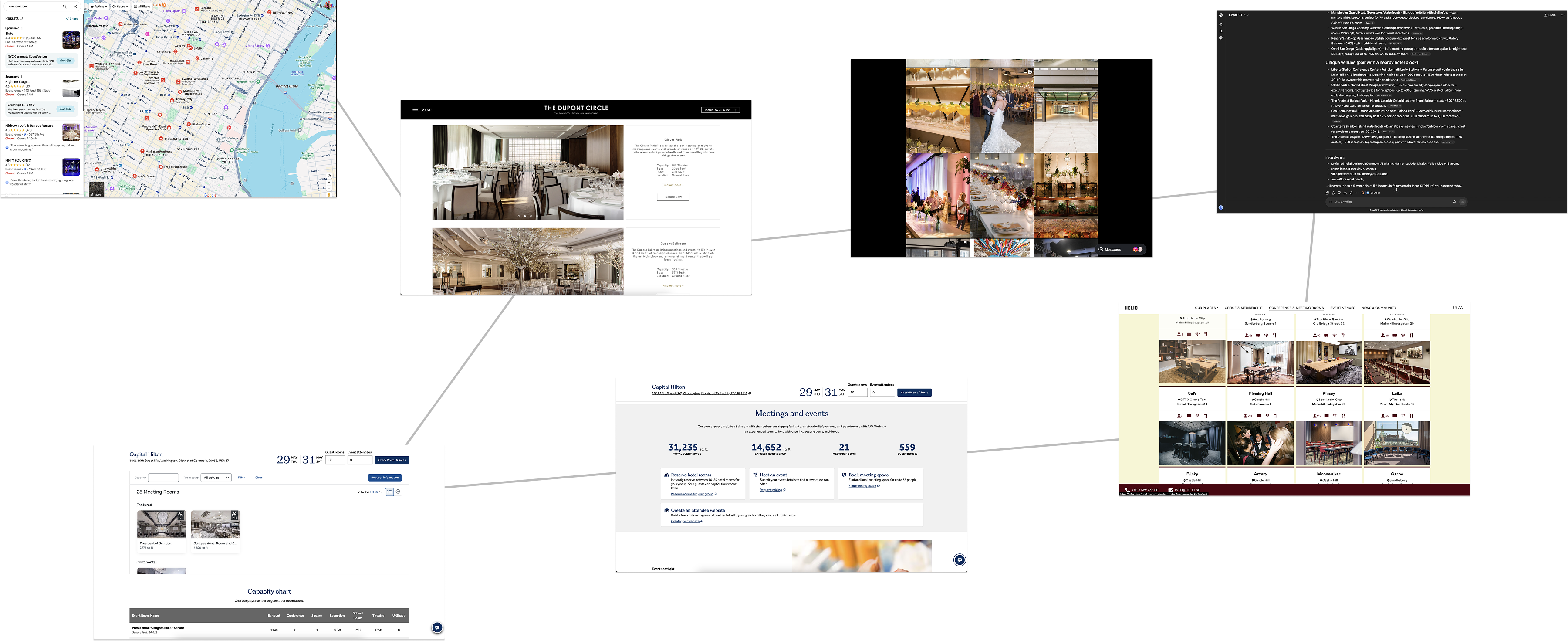
Eventually, all this investigative work leads them to stitch together a DIY "marketplace." It takes days, weeks, sometimes months. And all they wanted were three things: price, dates, and vibes.
What's crazy is they might have a $50k piece of business, a totally normal group spend, and this is still the "first click" experience 🫠.
The property's experience
On the other side of this, turns out properties are focused on the same three things:
- Pricing
- Availability
- Vibes (is this group going to be great or a nightmare)
Without open market dynamics, pricing becomes guesswork. So many venue owners say some version of:
"I struggle with what to charge so I just compare it to last season."
Take note: they are looking at data that is not market data, it is just their own property last season. But because the market is hidden behind webs of emails and web forms, that is all they have. Imagine if airlines or any other business only looked at their own past flights and never at competitor or market pricing. Would this make for optimized revenue management?
If you talk to hotels you hear the same theme:
Sales:
"I email revenue management and wait for a rate"
Meanwhile, the guest is talking to ten other places 😬.
Revenue management:
"I look at the convention calendar, our previous rates, ADR, and maybe <insert legacy system we pay tons of money for>, but to be honest nobody really uses it."
The shared problem
Both sides have the same goals in discovery: pricing, availability, and vibes. The problem is the friction between them.
With no open market or transparent supply and demand signals, pricing becomes guesswork. Both sides end up overpaying or undercharging without even knowing it. Availability turns into a long back-and-forth because nothing is connected in real time. And vibes only really come together at the site visit; everything before that is forms, emails, and vague details.
The matchmaking is where the majority of friction sits.
The market
The current state
Group business is a 1 trillion dollar market. To get a sense of its impact, consider that Marriott's CEO reported that 24% room nights came from group business, roughly double their OTA bookings.
And yet, two surprising truths remain:
- There is no group OTA or transparent marketplace
- You cannot instantly book 9 or more rooms
To me, this is wild. First, the barriers customers go through just to give properties money are staggering. And second, Expedia (~$30 billion), Airbnb (~$70 billion), and Booking (~$160 billion) are thriving in individual travel, yet there is still no true group OTA or marketplace dynamics driven by transparent supply and demand. It remains a hidden market living inside emails, forms, RFPs, and legacy systems.
The tools that do exist are not introducing market dynamics. They either double down on the RFP convention for properties (proposal builders, workflow tools, templates) or they are aggregated listings that look like a marketplace at first glance. In those listings you browse, express interest, and the system fills out forms on your behalf before returning results in a tidy UI. It is a step above the DIY process described earlier, but still not an open market.
And when you look at OTAs and listings in general, it is worth asking why guests increasingly go to Expedia, Booking, and Airbnb. It is because these platforms give them something direct channels do not: the dynamics and information of an open marketplace. Transparency, filters, instant pricing, and side-by-side comparisons. It is supply and demand working the way people expect today.
Innovation by way of transparent market dynamics
Here is a parallel analogy: we know the Uber and Lyft solution, but what was the actual problem?
Consider the cab experience before them. Everything came down to manually parsing pricing, availability, and vibes between two parties. As a customer you had to figure out which cab was available, flag them down, hope they stopped, then deal with bargaining that might be honored, ignored, or complicated by a "broken" meter. Drivers had their own issues like getting stiffed or wasting gas hunting down customers. And on both sides there were trust and safety concerns.
Then Uber came along. The core breakthrough was not the technology. The innovation was introducing transparent market dynamics to both parties. Suddenly both sides could see pricing, availability, and vibes through reviews in real time.
note: our customer today is the property. We are not building a group OTA now. We are solving the property-side problems of on-demand sales, pricing, availability, and qualification. If an open market for groups ever becomes possible, it will emerge from solving this foundational issue first.
Themes, patterns of and guest expectations
All of this is happening while demand for IRL experiences keeps rising. Ari Emanuel, CEO of Endeavor, is making huge bets on IRL entertainment. Airbnb is betting on the same trend with Experiences, and Booking.com continues to exceed expectations. These are only a few examples, but the pattern is clear: demand for real-world experiences keeps growing.
And while demand increases, customer expectations have never been higher. People have become accustomed to better design and higher quality tools at work and in everyday life. But when they try to plan a group, they fall back into 2007-era workflows: attachments, forms, PDFs, and email chains. This is the level of hospitality guests are met with at first click 😕.
Solution foundation
All of this sets the stage for where we begin. We are starting where the friction is worst: on-demand sales matchmaking between guests and properties, with the goal of saving time for both sides and helping properties win more of the right business.
So far, we've built Line to structure a property's knowledge so an agent can understand how the property wants to engage with guests and organize incoming inquiries clearly.